"'Foreign' Expertise: American Studies in Taiwan"
by
Richard P. Horwitz
E-mail: Richard-Horwitz@uiowa.edu
WWWeb: http://myweb.uiowa.edu/rhorwitz
Copyright
© 2020
A version of this essay also appears in
American Studies International 27:1 (April 1989), pp. 38-62. .
In Taiwan in 1978 a group of about fifty people organized themselves around common interests in the English language, foreign affairs, and the United States. They called themselves “Chung-hua-min-kuo Mei-kuo-yen-chui Hsueh-hui” (the American Studies Association of the Republic of China) or “the ASA/ROC.” At the time one might have guessed that interest in American studies had spread overseas, and it still looks that way. The ASA/ROC can be considered a variant or derivative of interests institutionalized (as the American Studies Association or US ASA) a couple of decades earlier in the United States.1 In fact, the groups have a good deal in common, and their relations are increasingly close. Such cross-cultural relations were the focus of my research in Taiwan in 1984-85.
Although generously supported by the National Science Council of the Republic of China (ROC), I began with serious handicaps, particularly ignorance. When I arrived in Taipei, I knew a good deal about the history and methods of American studies in the US, but next to nothing about its foreign practice. It seemed simple enough to learn, certainly simpler than folk medicine or Taoist ritual. I fashioned myself a participant-observer of educational exchange. I would learn how ROC scholars practice my field, and explain to them how I practice theirs. We could come to agree or agree to disagree as the exchange unfolded.
Of course, my position was naive. But its premises are not, I think, so unreasonable or unusual. In fact, both proponents and opponents of educational exchange frequently make similar assumptions. Faced with the two American studies associations, one might suppose that:
- The associations include similar sorts of people – developing and professional authorities from the same social sector;
- The members do similar things – study the US, read, write, discuss common materials;
- But they have contrasting perspectives – outside vs. inside, far vs. near, East vs. West.
In short, one might presume that American studies in the ROC and in the US are complementary, and therefore (depending on one's politics) they invite or defy integration. That view is a key reason international education/propaganda is supposed to be such an effective bridge or bludgeon. This article is intended to challenge such reasoning. In particular, I will analyze the ASA/ROC and assess ways that its members, their backgrounds, interests, and activities are related to those in the US ASA.
Of course, one reason to distinguish Chinese American studies is its relatively short history.2 US Americanists incorporated in 1951, just two years after the Kuomintang fled to Taiwan and twenty-seven years before there was an ASA/ROC. Analogous professional tenure would be impossible. But origins are not so neatly dated, and the difference may be trivial.3 Sino-American educational exchanges date from the mid-1800s, and more than a century has passed since the Chinese government began sending young men and women to the United States explicitly to learn Western ways. At the same time Western missionaries ventured to save them the trip.4 Of course, there was always more than education at stake. Missionaries were, among other things, saving souls, and governments were pursuing complicated economic and strategic objectives. The combinations of interests are difficult to read, much less compare.
For example, the government of the United States has long tended its image abroad. Since World War II exporting American studies has been a small but growing part of that effort.5 The Department of State has elevated American studies from a desk to a bureau. US Fulbrighters have become a global feature of prestigious universities with courses on American culture. Similarly, while US agronomists or Medievalists might be limited to a single Fulbright award, Americanists are encouraged to apply for a second or third. Cultural affairs officers have learned to add such professors to their list of frequent visitors. Now the US American Studies Association includes international cooperation among its highest priorities.6 It has always been among the highest priorities of such associations outside the US. So the aims of these efforts have varied as much as their pace. “Exported” American studies can be viewed as a response to demand, a gift of expertise, a fair trade for understanding, or pure propaganda. It is a “hand across the water” or “ American cultural imperialism.”7 Alternatives of this sort seem to know few borders, and they share a supposition that exchanges are effective or at least well-targeted for spreading common knowledge. Fundamental differences are unlikely to be defined.
In some obvious ways, Americanists are similarly organized almost everywhere. Both the US and ROC associations are voluntary, national registries of adults with educational designs. Neither is particularly well known outside of academic circles. They cultivate connections between various nations, but they share a focus on one, the United States. Officers, generally well-credentialed men, are elected by dues-paying members. Both groups lobby for research support. They hold annual meetings, organize symposia, and publish proceedings punctuated with bibliography. In short, they promote American studies.8
But it is less obvious that they understand or enact that objective in a similar way. When, for example, ROC and US Americanists pursue their interests, what contexts do they presume? Are they operating from the same realm of possibilities? Might the common label, “American studies,” simply deflect attention from their differences, not just in perspective but also in personnel and action? We can begin to answer such questions by beginning with the most elemental: Who identifies with American studies in the ROC?
Clearly, no members are exactly alike, but the rolls of the ASA/ROC reveal some very general patterns. Although not very detailed, the records are quite complete. They provide basic biographical information on the 325 people who registered their American studies affiliation in Taiwan in 1985.9
It should be no surprise that many more people registered in the US that year, a total of 2300. One would expect interest in any area to be far more common and intense “at home” than anywhere else. The US is where American studies was first organized, where patriotism (albeit reformist or critical) supports its practice, and where international myopia reigns.10 Witness, too, the comparative wealth of resources for study of any sort within the US.
|
US |
ROC |
Total Population (millions) |
241 |
20 |
Per Capita Income (US$ in thousands) |
12 |
3 |
Colleges/Universities |
3280 |
28 |
For every person in higher education in the ROC, there are more than forty in the US, with much greater financial support.11
The US advantage is even greater for American studies in particular. In addition to high school courses, the US supports about 400 programs in colleges and universities. Many of them have been awarding degrees, sixty of them graduate degrees in American studies, for twenty to thirty years.12 The ROC has never had more than five. The sole graduate program has only admitted about twenty students per year since 1974, and its resources have been extremely limited. For example, in 1979 as in 1969, evaluators found library facilities in the ROC barely adequate for basic undergraduate courses and inadequate for graduate or faculty research .13
The point is not to belittle Taiwanese achievements but to stress their relative magnitude. Given the luxury surrounding study in the US, especially American studies, we might well expect any US association to dwarf its ROC counterpart. But that is hardly the case. In fact, when the difference in population alone is taken into account, the membership of the ASA/ROC is nearly double that in the US. Considering, too, differences in educational opportunity, the ASA/ROC is huge.14
Furthermore, the membership is extremely active. Academia Sinica, the national research center in the liberal arts, has dedicated one of its fourteen institutes to American inquiry. With two buildings, a 35,000-volume library, a publication series, and about thirty researchers, it is an impressive facility. The number of journals in the field published in the ROC rivals the number in the United States. When, again, the difference in resources is considered, such a level of activity is staggering.15 And these are not (at least not entirely) US State Department, US Information Service, or Fulbright creations. The US government has maintained a low profile in Taiwan since derecognition in December of 1978. Americans are now a rare sight in Taiwan, but interest in studying their culture apparently remains. Recently, for example, 129 men and women applied to Tamkang University for just eighteen openings in its American Studies M.A. program. In fact, the competition for admission to programs related to America is keener than it is for those related to China.16
In this context, just one number, 325, the ASA/ROC roll, has some important implications. First, a remarkably large number of people in Taiwan claim interest in American studies. The reason is unclear. Certainly the strategic, economic, and diplomatic fate of the ROC lay with the US before 1978, and the continuing clout of the Department of State as well as its interest in American studies cannot be ignored, but neither can domestic circumstances. Second, Taiwanese interests in American studies cannot be as exclusively based in college or university programs as they are in the US. The resources simply are not there. Clearly, then, whatever the source of their interest, it is distinct. There is much more separating Americanists in the US and the ROC than nationality or the Pacific. Third, the ASA/ROC is a good place to examine such differences more closely. Judging from size alone, it must well represent American studies in Taiwan.17
In both countries, the leaders, the most recognized experts on American culture, have tended to be middle-aged men connected to prestigious academic institutions. Of course, the institutions are different and in Taiwan much smaller in number. Three of them, Academia Sinica, National Taiwan University, and Tamkang University, have been best represented. Hence, while the US ASA has generally been run from coastal and Midwestern centers, the ASA/ROC is effectively controlled in a single northern city, Taipei. Of course, such a concentration might be anticipated in a small island nation. More surprising is the extent to which leaders share an American education.
As in many other fields in Taiwan, a foreign degree, especially an American one, has long been the credential of rank. For example, despite its erratic, often racist immigration policy, the US trained the largest number of the most prominent Chinese professors of the last generation. In 1948, seventy-five of the eighty-one members of Academia Sinica were trained in the West – fifty-two of them in the United States.18 Now as then, an academic leader has to pass foreign muster. Generally, the more prestigious Americanists' position in a university in Taiwan, the more likely they are to have studied in the US. Note, for example, results from a questionnaire completed by more than a third of the members of the ASA/ROC in 1985.19
ASA/ROC |
All
Members |
All
Faculty |
Faculty of
Nat'l U |
Number of respondents |
116 |
78 |
29 |
Spent over 1 yr. in US |
35% |
46% |
76% |
Hold MA earned in US |
21% |
27% |
31% |
Hold PhD earned in US |
20% |
28% |
41% |
Whether out of generosity, fair trade, or imperialist design, the US is training its own observers. In the same survey, eighty-five percent of the members with a Ph.D. (twelve of thirteen in the national universities) earned those degrees in the US. While representing a small minority, then, even of Americanists in Taiwan, these scholars could be expected to “Americanize” the field. In an interview an officer of the ASA/ROC explained: “Of course we will publish our research in English; it must be up to American standards. That is the international standard.” One key difference between the two associations, then, is the source of their leaders' distinction. US Americanists are largely esteemed for defining and enforcing their own standards, ROC Americanists for successfully exposing themselves to someone else's. In this respect, when Americans welcome Chinese colleagues they do not engage “the Chinese point of view” or “foreign expertise.” Expertise itself is a US export. The training of ROC Americanists is more foreign to the ROC than it is to the US.
But this is not to suggest that these people have been Americanized. As we will see, there is a good deal of evidence that they have not, that their perspective remains avowedly “Chinese.” Yet, too, the role of the US – in funding, supplying, recruiting, training, and certifying experts – must be acknowledged. For example, the American Cultural Center of AIT and the Institute of American Culture at Academia Sinica have the two most extensive libraries on US subjects; USIS employees furnished nearly all of the volumes in one and about three-quarter in the other.20 At the very least, under present arrangements we cannot assume that Taiwan Americanists provide a vantage that is decidedly “cross-cultural” or “foreign” relative to the US. From different ends of a one-way street, the leaders of the field share important connections.
Considering the memberships as a whole, the associations also share an academic base. Most of the members have a college or university address, usually as faculty.21 While the US association has aimed to broaden its appeal beyond the ivory tower, the ASA/ROC has aimed to control its spread. For example, the US ASA has launched a number of programs to recruit high school, community and junior college teachers or administrators, curators, public historians, and the like. Still, in 1985 fewer than one in ten members was employed outside the academy. In the ASA/ROC their number was closer to three or four in ten.
Occupations in the ASA/ROC, 1985
College/University professor or researcher |
50% |
School teacher or administrator |
17% |
Graduate Student |
14% |
Government, party, or civil servant |
9% |
Junior college teacher or administrator |
3% |
Other business or profession |
7% |
In this respect, the Taiwan association is more diverse, less narrowly academic, than its US counterpart.22
That diversity is especially remarkable because the enrollment procedures are more restrictive. In the US the only requirement is a modest, annual charge. Initiation and membership fees for the ASA/ROC are even lower, but one must earn the right to pay them. A board of directors must vote to accept each applicant, and the constitution directs them to demand a record of study, employment or publications “related to American studies.” Although reviews of these records are perfunctory, a bachelor's degree is invariably required. Every application must also include the written recommendation of two people who are already members.23
Hence, although the ASA/ROC is relatively diverse, it is designed to be exclusive or at least honorific. A colleague explained, “American associations like the ASA, the OAH, the MLA – they are more scholarly; ours are more social.” Of course, the US ASA is also largely social. It honors selected members and helps publish their work. It represents them in larger organizations like the ACLS. And it sponsors occasions where people mainly “socialize.” But the ASA/ROC has yet more powerful social functions. In addition to bringing prestige to its officers, their allies, and their institutions, the association can provide substantive rewards. Its executives, for example, help screen proposals for conferences, publications, and international travel or study awards like those administered by USIS. Among the rewards potentially bestowed by the ASA/ROC, then, is easier access to US resources. Once again, in this respect, the association is less an independent observer than an international liaison. Neither association, however, reflects the diversity of its nation very well. Of course, members have extraordinary formal education and a high rate of employment. These are among the biases of a professional society that seem natural, even if objectionable. But other varieties of exclusion defy justification. For example, the US ASA has infamously over-represented male Euro-Americans. Although more than half of the citizens (and 40 percent of the members) are female, a women president was not elected before 1985. Members whose ancestors are Africans, Asians, Indians, or Latinos might well feel more out of place at an ASA convention than on an ordinary urban street.24
The background of ROC Americanists seems even more select. For example, the ASA/ROC is a masculine dominion. Women constitute barely a quarter of the membership. Ethnicity, too, is even more skewed than it is in the US. While less than 15 percent of the population are Mainlanders (Chinese who immigrated in 1948-49 and their descendants), they constitute 45 percent of the ASA/ROC.25 And these biases generally increase with rank – from young to old, student to professor, member to officer. Of course, such patterns do not prove deliberate discrimination. Sexism and white racism are hardly explicit priorities of the US ASA, and the ASA/ROC is hardly the base of Mainlander patriarchy. For example, it was the national government that made Mandarin (vs. Taiwanese) the language of instruction in public schools. Although women commonly outscore men on qualifying examinations, they are vastly outnumbered among the beneficiaries of the educational system as a whole.26 But whether through outright exclusion or benign neglect, a decidedly select “knowledge class” is apparent, and international cooperation may just as easily harden as reform structures of inequality.27 With or without the support of US Americanists, the ASA/ROC can be said to represent a “Chinese” point of view only in a very special sense. Even more decidedly than in the US, critics scan the cultural horizon from the upper tiers of a domestic social hierarchy.
Such elitism is to be expected in a Chinese context. While academics are well respected in both countries, they have a much longer, more explicit tradition of public distinction in China. For example, scholar-moralists comprised a ruling gentry before the birth of Christ. Their standing was counseled by Confucian principles and enforced by a civil service system established by the tenth century. National examinations still make the university the key route to prominence in government bureaucracy. Moreover, the university itself is considerably more hierarchical in the ROC than in the US. Professors are to be masters and models of civility; students their humble, obedient charges. Education focuses less on self-expression or intellectual combat than public virtue, in particular the virtue of an orderly system of altruism and deference which scholars know and teach. Of course, these ideals are not the subject of eternal, universal conformity, but in general Taiwan scholars, including those in the ASA/ROC, occupy a singularly high position in their society. While US Americanists style themselves mavericks, independent observers and critics of the national “establishment,” ROC scholars share in traditional authority. They are the establishment.28
Such historical, organizational, and demographic patterns are highly suggestive. In particular, they suggest that my original presumptions (at least the first and third) are not quite right. Americanists in the two countries are less similar than might be expected. The ASA/ROC represents a larger, more occupationally diverse, more foreign-educated, and generally more elite proportion of the citizenry than the US ASA. At the same time their perspectives may be far more similar than expected. The role of the US in developing an elite corps of Taiwan Americanists puts their status as “outsiders,” “the East vs. the West,” into question. Insofar as understandings of the US seem compatible, we might now expect that the reason is simply US domination and class solidarity rather than a convenient complement of activities and perspectives.
But it is not so easy to prove such an interpretation. I have highlighted a number of “influences” and “reasons to expect” but said little about what these people actually think or do, and there is not much of a systematic record to help. The best I can do to is to pursue my interpretation in the results of the 1985 surveys and in the impressions I gained in the field.29
They, too, suggest significant differences in the workaday experience of the two groups. In the ROC, as in the US, members say they spend a lot of time studying, but in the ROC less than half devote much of it to teaching. In fact, a third do not teach at all, while administrative and government duties occupy a significant minority.30 These findings generally affirm that American studies is far less strictly academic in the ROC than in the US.
As one might expect, Taiwan Americanists spend much of their time translating. Most of their sources, like those books donated by the USIS, are in English. Nearly everyone agrees that more publications should be available in Chinese, and Fulbrighters from the US note that they spend more time teaching English than anything else.31 The importance of language training in ROC American studies might be compared with the conflation of language, history, government, and literature in the “area studies” programs developed in the US after World War II. Americans learn Chinese through ”Asian Civ,” and they learn about Louis XIV in “French 101.” So, the parallels are familiar, but they exist across fields rather than within any one. In the US “English composition” is not an American studies course; in the ROC, in effect, it is – learning English and learning about the US are barely distinguishable.
That fact may account for much of the field's popularity. English has very special significance in the ROC. A student may need a second or third language if he/she wants to work as a flight attendant or a journalist, in a trading company or the post office. And without it he/she may face a lifetime of back-breaking or mind-numbing employment. In the “marriage market,” too, a man with a degree in the liberal arts (especially the humanities) may lose value, but the bidding goes up if it certifies that he is bilingual. The relationship, then, between English and American studies in the ROC is part of a whole complex of conditions with few parallels in the US.
On the other hand, strong ties have always existed between English literature, its criticism, and American studies. For example, classic works in the field (the so-called “myth-and-symbol” variety) privilege fiction, and literature is the most common specialization reported in both countries.32
Members of US ASA |
Members of ASA/ROC |
FIELD OF SPECIALIZATION |
#1 American Studies (28%) |
#1 English Literature (23%) |
#2 Literature (21%) |
#2 Foreign Languages (20%) |
#3 History (19%) |
#3 Political Science (11%) |
FOCUS |
#1 Literature (19%) |
#1 American Studies (24%) |
#2 Women's Studies (12%) |
#2 Foreign Languages (16%) |
#3 Cultural History (9%) |
#3 English Literature (14%) |
Bibliographies give the same impression. Although Americanists just about everywhere are using more historical and survey data of late, for the past couple of decades journal articles have featured fiction more than any other source.33
But important differences remain. The attention to English language may be similar in degree, but it is hardly similar in kind. The heavy stakes attending a mastery of English, the challenge of translation, of teaching composition and comprehension in a foreign code, and of broader inequalities between the US and the ROC make the language arts an illusory meeting ground. The political and economic power of the US lends a significance to the English language that shapes American studies around the globe in ways that talk of “perspectives” and “points of view” may too easily miss.
When we turn to less hegemonic interests, disparities are even more striking. Women's studies and history vie for a strong second in the US; in the ROC they are barely represented. Apparently nearly all of the historians in ASA/ROC were trained in Asian, comparative, or diplomatic history. In fact, many of them who were trained in the US note that they were discouraged if not barred from non-Asian specialties.
While US Americanists claim to span the humanities and the social sciences, their association does not. Fewer than 4 percent of the members hold their highest degree in any of the social sciences. Only thirty-two of 2300 members list “government” among their top three interests. In this respect the ASA/ROC can make much stronger interdisciplinary claims. More than a third of its members hold advanced degrees in the social sciences, and about 20 percent focus on politics or international affairs in particular. If, then, the language arts provide a collective (albeit superficial) center for American studies in the two countries, the periphery pulls them yet further apart. In the US, the pull is from literary criticism toward history and the humanities; in the ROC, it is from foreign languages toward politics and the social sciences.
This difference is most obvious as Chinese Americanists report their sources of information. Comparable data are not available on the US ASA, but it is hard to believe that they would resemble the following. I asked:
In studying American culture, which materials would you choose
to reflect dominant modern American values?
Mirror of Dominant Values |
Share of ROC
Respondents Citing |
#1 Domestic political oratory |
46% |
#2 Opinion polls |
46% |
#3 Mass circulation periodicals |
41% |
#4 Diplomatic policy |
40% |
#5 Technology |
40% |
#6 Voting Behavior |
30% |
These responses suggest the importance of politics for Taiwan Americanists. Apparently when they want to infer American values, they look to government, to the sorts of public postures and pie charts that punctuate Time and US News and World Report. In fact, these magazines are among the most available and trusted English reading materials in the ROC. Among US Americanists they are more often materials for deconstruction and distrust.
The ranking of sources is especially remarkable in light of the members' training, interest, and publications. What happened to literature? “Literary classics” found its way onto a list of mirrors of modern values only in eight of 116 cases; “autobiography” only in six. “Business records” received a stronger vote of confidence than the two put together. From a US point of view such priorities are curious. The whole field of American studies originally developed in the US around what was supposed to be the unique reflective power of canonical literature. Even now the works of Angelou, Momaday, and Pynchon certainly figure in standard references more often than Merrill Lynch. Again, the evidence undercuts the original presumptions. Taiwan Americanists consult distinct kinds of sources. When they ”do American studies,” they are not doing the same thing as their US counterparts.34
The difference is less striking when we consider popular arts. Among the arts, for example, best-sellers top the list of values reflectors in the ROC survey, as they might with even greater frequency in the US.35 Popular arts figure yet more strongly among Taiwanese sources for detecting American lifestyles.
Which materials best reflect dominant modem American ways of life?
Mirror of Dominant Ways of Life |
Share of ROC
Respondents Citing |
#1 TV programs |
64% |
#2 Mass circulation periodicals |
42% |
#3 Music |
35% |
#4 Technology |
31% |
#5 Best-selling fiction |
27% |
In light of the boom in popular culture studies in the US, these results suggest converging interests on both sides of the Pacific. But two considerations suggest the contrary. First is the poverty of popular culture sources actually available in Taiwan. For example, even in Taipei the three television networks broadcast less than half of each day, and imported programs cannot fill more than one hour in ten.36 In 1985 regular US programming was limited to aged reruns of Dallas and Three's Company a couple of late-night hours each week. Although middle-of-the-road Rock and Hollywood films are popular among Taipei students, they are hardly part of their curriculum. None of these media is available in research libraries. Second, in the ROC these media attract scholarly analysis on the rarest of occasions. For example, although a large majority of the respondents find TV a key indicator of American ways of life, few articles have ever been published on the subject in a Taiwan American studies journal.
Together these two factors suggest that Taiwan and US Americanists share an interest in popular sources, but what they know of them and what they do with them seem barely comparable. Note, for example, the difference between the two rankings. The first question is directed at evidence of values, and the second at evidence of ways of life. And compare the answers. The first set (for values) is relatively “hard” – behavior, policy, polls, the traditional dominion of the social sciences. The second (for ways of life) is “soft” – fictions, music, artifacts, the dominion of the humanities. Certainly, such a hard/soft dichotomy is conventional as well in the US, but such an application of it is not. In the US, Americanists generally suppose, values find soft expression and behaviors hard; that is, “Dallas” might well suggest viewers' fantasies, maybe even their beliefs, but only very indirectly the way they actually live. Taiwan Americanists seem to assume the opposite or something else altogether.
I am not sure how best to explain this difference in perspective. In follow-up interviews, informants agree that the questionnaire properly invited respondents to posit relationships between varieties of evidence and properties of groups. What it did not invite was an explanation, an account of what there is, say, about TV that better bespeaks lifestyle than values or what there is about behavior (vs. belief) patterns that make them more evident in some sources and less in others. I have only fragments of an answer. For example, one informant suggested, “We Chinese think of ways of life as the ways of our forefathers: Values come and go. We may think we are living differently or for different reasons, but we will always act Chinese.” I am not sure how pervasive is this view – a view of values as transitory and behavior patterns as fundamental, the reverse of the usual US search for “the principles on which we stand” – but it would help explain some of my findings. It also suggests how subtle cultural differences may have profound implications for scholarly exchange.
In short, US and ROC Americanists seem to consult different sources. For mundane matters or simple facts – how many people live in Indiana? what was the Trail of Tears? – the difference is probably slight. But in more generally characterizing the US, the two groups look in different directions. When they look in the same direction, they have different destinations. Of course, the evidence for this interpretation is itself questionable, but we now have at least some reason to restore our presumption that the difference between American studies in the US and in the ROC includes perspective. Scholars may not only occupy a different place in their society and deal with different materials but also approach those materials from distinctive points of view. There may yet be cultural as well as social chasms between the US and the ROC that common vocations and “cultural imperialism” fail to bridge.
When asked as directly as possible, most Taiwan Americanists find the US foreign, indeed.
Of course, citizens of every country are diverse, and they may respond differently to each situation.
But in general, in your opinion, how well does each of the following terms fit Americans?
How well does each term fit most Chinese? How well does it fit you?
(1 indicates the term fits very poorly, 5 indicates the term fits very well.)37
|
FIT (Mean Score) |
ATTRIBUTE |
Americans |
Chinese |
You |
Free |
4.7 |
3.3 |
3.9 |
Athletic/sports-loving |
4.6 |
3.0 |
3.2 |
Independent/self-reliant |
4.6 |
3.2 |
4.1 |
Materialistic |
4.4 |
3.4 |
2.9 |
Sexy/erotic |
4.3 |
2.8 |
3.1 |
Rich |
4.1 |
2.9 |
2.7 |
Playful |
4.1 |
2.9 |
2.8 |
Geographically mobile |
4.1 |
2.4 |
2.7 |
Diligent/hard-working |
4.1 |
4.4 |
4.4 |
Egalitarian |
4.1 |
3.3 |
4.2 |
Religious |
4.0 |
3.2 |
2.8 |
Clean/tidy |
4.0 |
2.9 |
4.0 |
Honest |
4.0 |
3.4 |
4.2 |
Studious |
3.6 |
3.9 |
4.2 |
Patriotic/nationalist |
3.6 |
3.8 |
4.2 |
Aggressive |
3.5 |
2.4 |
2.1 |
Self-critical |
3.3 |
3.6 |
4.1 |
Generous |
3.2 |
3.7 |
3.7 |
Formal/restrained |
3.2 |
4.1 |
4.0 |
Violent |
3.0 |
2.5 |
1.6 |
Traditional |
2.8 |
4.1 |
3.7 |
Superstitious |
2.4 |
3.8 |
2.1 |
Family-oriented/ filial |
2.4 |
4.3 |
4.3 |
It may not be surprising that they accent the differences between Americans and Chinese. Stereotypes of East and West exist on both sides, and the terms were largely selected to capture that fact.
Americans come across as well-heeled achievers, light on commitments and adept in taking care of themselves. The traits that Taiwan Americanists stress in 1985 are hardly very foreign to the US. They greatly resemble those that Frederick Jackson Turner traced to the western frontier in the previous century:
That coarseness and strength combined with acuteness and inquisitiveness; that practical, inventive turn of mind, quick, to find expedients; that masterful grasp of material things, lacking in the artistic but powerful to effect great ends; that restless, nervous energy; that dominant individualism, working for good and for evil, and withal that buoyancy and exuberance which comes with freedom.38
The traits that ROC respondents assigned to Chinese would please Confucius or Mencius. They include plenty of jen (humanity, benevolence) and such correlatives as Ii (propriety), hsiao (filial piety), chung, (faithfulness), and shu (reciprocity). Taiwan Americanists find their compatriots more tied to family, home, spirituality, and tradition and less devoted to theology, sensuality, play, or ambition than the Americans they study. Chinese may be poorer, more superstitious or sloppy, but they are also more generous, peaceful, and respectful of their associates and ancestors. Americans may be more stingy or aggressive, but they are also more liberal, wealthier and, in a way, more fun. The survey leaves no doubt that such bold distinctions are assumed.39
ATTRIBUTE |
DIFFERENCE IN STEREOTYPES (Standardized Means) |
US-China |
China-Self |
US-Self |
Geographically Mobile |
-1.63 |
-.23 |
-1.40 |
Athletic/sports-loving |
1.57 |
-.19 |
1.38 |
Sexy/erotic |
1.48 |
-1.02 |
.47 |
Independent/self-reliant |
1.41 |
-.81 |
.60 |
Free |
1.30 |
-.51 |
.80 |
Playful |
1.18 |
.03 |
1.20 |
Rich |
1.15 |
.10 |
1.25 |
Aggressive |
1.02 |
.24 |
1.26 |
Clean |
.95 |
-.93 |
.02 |
Materialistic |
.87 |
.40 |
1.27 |
Religious |
.80 |
.34 |
1.14 |
Egalitarian |
.67 |
-.72 |
-.05 |
Violent |
.54 |
.87 |
1.42 |
Honest |
.52 |
-.73 |
-.20 |
Self-Critical |
-.13 |
-.43 |
-.56 |
Studious |
-.23 |
-.23 |
-.47 |
Patriotic/nationalistic |
-.27 |
-.35 |
-.62 |
Diligent/hard-working |
-.28 |
.05 |
-.23 |
Generous |
-.49 |
-.01 |
-.50 |
Formal/restrained |
-.80 |
.00 |
-.80 |
Traditional |
-1.22 |
.31 |
-.91 |
Superstitious |
-1.34 |
1.49 |
.15 |
Family-oriented/filial |
-1.74 |
.00 |
-1.74 |
But two more subtle patterns are surprising. First, note how closely self portraits resemble the Chinese stereotype. They are closer to the American standard in just six of twenty-three respects.40 In most respects respondents consider themselves only slightly more American than “most Chinese.”41 The only distinct exception is in the respondents' own devotion to study, patriotism, self-criticism, and non-violence which, they say, is typically neither American nor Chinese in depth. Without surveying the population as a whole we cannot be sure that they are right, but respondents strongly suggest that they have hardly been “Americanized.”
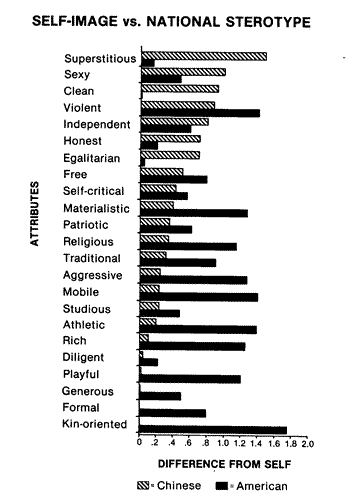
Second, this generalization applies uniformly to groups in the ASA/ROC that could be expected to differ. Clearly, larger samples would help, but I have not yet been able to identify any ways in which scholars' occupation, age, training, field, gender, ethnicity, prestige, or methods shape their impressions. There is remarkable agreement about the degree and kind of differences that should be attributed to Americans and Chinese, an agreement that cannot be simply traced to the effects of cultural exchange. I can say which members have spent time in the US, the length and purpose of their visit, and their overall evaluation of it. They vary considerably. But I cannot yet say how it matters or even that it matters at all in their image of the US. Great differences in social standing and experience with the US are just not significantly related to conclusions that ROC Americanists draw about their subjects, their compatriots, or themselves.
Some of these questions require far more detailed attention. Larger samples, in and out of the academy, would make it easier to identify more subtle ways that social stratification and scholarship relate. More information on practices in the classroom and the library would help establish the day-to-day significance of these patterns. Comparable data drawn from other countries and fields would help establish the limits of such generalizations.
But in this case – one field in a host and client state – we can find reason to doubt that cross-cultural integration or cultural imperialism have yet been accomplished. American studies in the two countries is singular in little more than name. Participants occupy decidedly different places in their societies and go about their business in very different ways. They entrust different sources of information. When they use the same sources, they have different purposes. Nevertheless they characterize the US in terms that are strikingly uniform and familiar. Whatever the depth, quality, and intensity of their contact with the US, Americanists in the ROC do not seem less “Chinese” than their compatriots. Without more information we cannot be sure. But in the meantime, we can urge much closer attention to their distinctiveness. It can be too easily obscured by the sheer might of the United States. This research, then, points to the need for more cross-cultural, contextualized conceptions of exchange and empire building, conceptions that take into account differences in domestic circumstance and global inequalities. As countries now join to internationalize American studies, there may be no better occasion for a truly open, informed debate on the meaning of “foreign” expertise.
Notes
-
For a brief, interpretive history of American studies in the United States, see Gene Wise, “'Paradigm Dramas' in American Studies: A Cultural and Institutional History of the Movement,” American Quarterly, 31:3 (Summer 1979), pp. 293-337. More brief, less interpretive but otherwise similar accounts have also appeared in the ROC. See, for example, Walter E. Hugins, “American Studies in the United States,” Tamkang Journal of Area Studies (November 1973), pp. 21-29; and Floyd Matson, “Images and Metaphors: American Studies as a Social Science,” Tamkang Journal of Area Studies, 2:2 (April 1981), pp. 182-191. Rudolph Chu provides a candid account of the early history of American studies in the ROC in “A Status Report on the American Studies Program in the ROC,” Tamkang Journal of Area Studies (Nov. 1973), pp. 4-20 or pp. 163-173 of Proceedings of the First Regional American Studies Seminar of East Asia, July 2-4, 1973 (Taipei: Institute of American Culture, Academia Sinica, 1973). See also Wang Shih-chieh, “Promoting American Studies,” American Studies [ROC] 4:3 (Sept. 1974), pp. 1-5; and John R. Moore, “American Studies in China: Problems and Prospects,” American Studies [ROC], 2:3 (Sept. 1972), pp. 358-366. American Studies International regularly includes articles summarizing the history and current status of American Studies around the world. See also Sigmund Skard, American Studies in Europe: Their History and Present Organization (Philadelphia: University of Pennsylvania, 1958), and Roger Hall, “To Our Readers: The View from Southwestern Ontario: Results of Our Opinion Survey,” Canadian Review of American Studies, 18:1 (Spring 1987), pp. 3-7.
Note that Throughout this essay I use” American studies” (small “s”) to refer to the field and” American Studies” only when it is part of a proper name. Readers must also be cautioned that this essay is written in the “ethnographic present.” It is a rapidly fading snapshot. Every characterization of current conditions should bear an implicit preface, “To the best of my knowledge in 1984-85 . . . .“
-
Here as elsewhere I use “Chinese” to refer to properties of the Republic of China in Taiwan, and ”American” for properties of the United States. Although these usages are politically charged, I do not mean to endorse any particular position on the relations between the governments of the PRC and the ROC or between the US and the other Americas, on the sovereignty of Taiwan, or on minority/majority rights. I do mean, though, to highlight continuities between Mainland and Taiwan affairs and to preserve common usage. However unfairly, people in the US ordinarily refer to themselves as “Americans” and people in Taiwan (especially in the ASA/ROC) call themselves “Chinese.”
-
Note, for example, that National Taiwan University has offered American history courses at least since 1951 and offered American literature courses as long ago as anyone can remember. Tamkang University founded an American Studies Division in 1965. American Studies was a quarterly publication of the China Council on Sino-American Cooperation in Humanities and Social Science from 1971, well before the ASA/ROC was officially begun. For American studies in general, then, any date of origin is arguable. See Rudolph Chu, “A Status Report on the American Studies Program in the ROC,” Proceedings of the First Regional American Studies Seminar of East Asia, July 2-4, 1973 (Taipei: Institute of American Culture, Academia Sinica, 1973), pp. 163-167; and William Ayers, “Remarks at the Inaugural Ceremony of the ASA of the ROC, January 22, 1978,” ASA/ROC Newsletter, No. 1 (July 1978), pp. 5-8.
-
In 1925, for example, most of the 8300 Protestant missionaries in China were American. By the mid-1930s those American missionaries maintained thirteen colleges or universities with more than 6000 students and 260 middle schools with 50,000 students. Nonreligious groups were also powerful. For example, from 1919 to 1933 the Rockefeller Foundation gave more money to China ($37,000,000) than to any other foreign country. Note, too, the significance of the Harvard Yenching Institute and the China Foundation for Education and Culture (the US indemnity from the Boxer Rebellion). James C. Thomson, Jr., While China Faced West: American Reformers in Nationalist China(Cambridge: Harvard University Press, 1968), pp. 35-39.
For a superbly detailed history of Chinese educational and cultural exchange see Wang Yi-Chu, Chinese Intellectuals and the West, 1872-1949 (Chapel Hill: The University of North Carolina Press, 1966). See also Chow Tse-tsung, The May Fourth Movement: Intellectual Revolution in Modern China (Palo Alto: Stanford University Press, 1967); Ralph Clough, Island China (Cambridge: Harvard University Press, 1978); John K. Fairbank, Chinese-American Interactions: A Historical Summary (New Brunswick: Rutgers University Press, 1975); John K. Fairbank, The United States and China, 4th Ed. (Cambridge: Harvard University Press, 1979); Francis L.K. Hsu, Americans and Chinese: Passage to Differences, 3rd Ed. (Honolulu: University of Hawaii Press, 1985); Neil H. Jacoby, US Aid to Taiwan (New York: Praeger, 1967); Kuan-shen Liao, Anti-foreignism and Modernization in China, 1860-1980: Linkage Between Domestic Politics and Foreign Policy (New York: St. Marin's Press, 1984); Patricia Neils, “American Sinology and its Sacred and Secular Prototypes,” Tamkang Journal of American Studies, 3:3 (Spring 1987), pp. 37-62; J.E. Sheridan China in Disintegration: The Republican Era in Chinese History, 1912-1949 (New York: The Free Press, 1975); Paul K.T. Sih, ed., Taiwan in Modem Times (New York: St. John's University Press, 1973); Jonathan D. Spence, To Change China: Western Advisers in China, 1620-1960, Rev. Ed. (New York: Viking Penguin, 1980); Tang Tsou; American's Failure in China, 1941-50 (Chicago: University of Chicago Press, 1963); and R.W. Wilson, Learning to Be Chinese: The Political Socialization of Children in Taiwan (Cambridge: MIT Press, 1970). For information on US/Taiwan cultural affairs in particular, see US Educational Foundation in the ROC, Ten Years of Educational Exchange (Taipei: US Educational Foundation in the ROC, 1967); Norman Wood and Walter Hugins, “The Fulbright Program in the ROC, 1947-1973,” Proceedings of the First Regional American Studies Seminar of East Asia, July 2-4, 1973 (Taipei: Institute of American Culture, Academia Sinica, 1973), pp. 123-130; and especially Chang Peng-yuan, “Sino-American Scholarly Relations as Seen From Taiwan, 1949-1979,” The American Asian Review, 1:3 (Fall 1983), pp. 46-86.
-
Although nearly all of the founders of the ASA/ROC insist that they were free to shape the association as they saw fit, they also point out that the association itself was something “encouraged” by the American Cultural Center and Fulbright. The Fulbright program dates from 1946 (Public Law 584, 79th Congress), but exchanges with the ROC had to await the American-Chinese Educational and Cultural Exchange Agreement of 1957, a delay for the Quemoy/Matsu shelling, and then appropriations. The program was barely organized before the Mutual Educational and Cultural Exchange (“Fulbright Hays”) Act of 1961 and barely funded before the late 1960s. Norman Wood and Walter Hugins, “The Fulbright Program in the ROC, 1947-1973,” Proceedings of the First Regional American Studies Seminar of East Asia, July 2-4, 1973 (Taipei: Institute of American Culture, Academia Sinica, 1973), pp. 123-130.
The Center and the Foundation for Scholarly Exchange still are important contributors/beneficiaries of ASA/ROC activities. For example, funds provided in 1984 by AIT (the surrogate US embassy in Taipei), mainly for a conference on the US Presidency, represented about half the income generated by the ASA/ROC that year. ASA/ROC, “Budget for 1984,” mimeographed handout from the 1985 annual meeting. For evidence of the continuing coordination of US foreign policy and the ASA, see for example, the explanation of the association's relocation to Washington, D.C. in the ASA Newsletter, 10:2 (June 1987), pp. 1-3; and CULCON XIII, Reports from the 13th Biennial Meeting of the US-Japan Conference on Cultural and Educational Interchange, July 1986, Tokyo, especially pp. 10,15-16. Of course, “coordination” does not mean conspiracy, but both parties are increasingly sensitive to opportunities for mutual advancement.
-
This development has attracted unusual attention. In The Chronicle of Higher Education, for example, see Karen J. Winkler, “Scholars Chide American Studies for Ignoring the Rest of the World,” (November 13,1985) and a reply by Carl Bode, “American Studies: Guilt for Being Provincial,” (December 11, 1985).
-
Such competing characterizations of exported American studies have a long, global history. See, for example, the exchange between R. Wagnleitner and Claude-Jean Bertrand in the pages of American Studies International, Vols. 24 and 25 (April 1986 and April 1987). The articles illustrate the formulaic quality of the debate. For example, Bertrand was able to revise a 1985 publication to make it read as if it were a response to an article published in 1986. More than twenty years ago, Howard Mumford Jones swung on the same gate: “It has been urged, usually as a reproof, that American Studies are in fact a branch of propaganda. I think this is not wholly bad, and I think the allegation perhaps puts us on the right track. American Studies are propaganda because they are an attempt to explicate and make persuasive a set of values satisfactory to the American people; and because the American people believe these values, or some of them, may benefit other nations, they are engaged in a mighty effort to make these values comprehensible both at home and abroad.” “'American Studies' in Higher Education,” in Essays on American Literature in Honor of Jay B. Hubbell, ed. Clarence Gohdes (Durham: Duke University Press, 1967), p. 7. This is the very passage that Russell Reising reprints to document the “imperialistic function of American studies.” Jones' “admission,” Reising writes, is unusual only in its “honesty.” The Unusable Past: Theory and the Study of American Literature (New York: Methuen, 1986), pp. 39-40.
-
Each American Quarterly begins with a statement of the goals of the US ASA. More detailed information on the association appears in the “Constitution,” available from the ASA office. Analogous information for the ASA/ROC can be found in “Constitution of the American Studies Association of the Republic of China,” ASA/ROC Newsletter, No. 2 (Autumn 1978), pp. 45-50. The only significant difference between their avowed purposes is the explicit attention to bilateral relations in the ROC document.
-
With the help of grants from the National Science Council of the ROC and the University of Iowa and the support of colleagues at the Institute of American Culture at Academia Sinica, I assembled most of the data in Taiwan while working at the Institute, 1984-85. Since the key officers of the ASA/ROC in 1985 were connected with the Institute, they were able to help me gain access to the files. They also helped me arrange interviews with leaders in the field. Several research assistants helped translate, code, and keypunch the hand-written records. They are all due my deep appreciation. I also wish to acknowledge the support services provided by University House, the faculty research center at the University of Iowa, which supported my work with Jae-On Kim, a colleague in Sociology, during the Summer of 1987.
-
For a concise history of US views of the ROC, see Leonard Unger, “Changing American Perceptions of Taiwan, 1949-79,” Asian Review, 1:3 (Fall 1983), pp. 1-26. Following William Watts of Potomac Associates, The United States and Asia-Changing Attitudes and Policies (Lexington, Mass: Lexington Books, 1982), Unger finds shocking ignorance of the ROC in the US. See also John K. Fairbank, China Perceived: Images and Policies in ChineseAmerican Relations (New York: Random House, 1976); Edward Friedman and Mark Selden, eds., America's Asia: Dissenting Essays on Asian-American Relations (New York: Pantheon, 1971); Sun Tung-hsun, “Some Recent American Interpretations of SinoAmerican Relations of the Late 1940s: An Assessment,” American Studies [ROC], 12:4 (December 1982), pp. 29-50; Creighton Miller, The Unwelcome Immigrant: The American Image of the Chinese, 1785-1882 (Berkeley: University of California Press, 1969); John Higham, Strangers in the Land: Patterns of American Nativism, 1860-1925 (New York: Atheneum, 1963); and Wu Chang-tsu, ed., “Chink”–A Documentary History of AntiChinese Prejudice in America (New York: World Publishing Co., 1972). US ignorance and intolerance of foreigners should be contrasted with the attention to domestic culture which, as Potter explains, is an American pastime. David M. Potter, People of Plenty: Economic Abundance and the American Character (Chicago: University of Chicago Press, 1954). See also, Thomas L. Hartshorne, The Distorted Image: Changing Conceptions of the American Character Since Turner (Cleveland: Case Western Reserve, 1968); and Philip Gleason, “World War II and the Development of American Studies,” American Quarterly, 36:3 (Bibliography Issue, 1984), pp. 343-358.
-
Figures were assembled from US and ROC government and commercial publishers, including: China Yearbook, Education Statistics of the ROC, Education in the ROC, Education Statistics Yearbook, The Europa Yearbook, Fact Book on Higher Education, International Encyclopedia of Education, Statistical Abstract of the United States, Statistic Yearbook of the ROC, Taiwan-Fukien Demographic Fact Book, and The World Factbook. When figures conflict, I cite those based on observations closest to 1985 and those which would be most likely to contradict my interpretation (i.e., those which minimize the difference in available resources).
By most accounts the infrastructure for a Western-style system of higher education barely existed before 1950. In that year there was only one graduate program in the country; more than 250 have been developed since then. Between 1949 and 1956, the research staff for Academia Sinica lived in an abandoned storage house of the Taipei railway station. As late as 1971 researchers reported that less than 75% of the faculty in the nation's graduate humanities programs held any post-baccalaureate degree· and fewer than 3% held a Ph.D. Even now most liberal arts faculty are trained in and depend on books and theories from the US. China Council on Sino-American Cooperation in the Humanities and Social Sciences, Joint Research Workshop, Report of Current Status and Developing Trends in Research Institutions in the Humanities (Taipei: Academia Sinica, 1971), p. 91. Chang Peng-yuan, “Sino-American Scholarly Relations as Seen from Taiwan, 1949-1979,” The American Asian Review, 1:3 (Fall 1983), pp. 75-80. Of course, many citizens from both countries pursue education overseas, but again the result is a larger pool of talent for the US. For example, in 1983-84 22,000 Taiwanese studied in the US, but only 800 Americans studied in Taiwan. Moreover, most of these Taiwanese would never resettle in the ROC. Between 1950 and 1983 less than 14% did. According to Kao Ming-hui, the US-educated Director of the ROC National Youth Commission, the 69,000 student émigrés during that period represent a loss of a billion dollars (46 billion NTD). “ROC Suffers Huge Brain Drain,” China Post, April 9, 1985. But the figure is arguably a net loss, and only a very few Americanists participated in this exchange or “brain drain.” The vast majority of Taiwanese students in the US are pursuing degrees in engineering, computer science, math, business administration, or the natural sciences. American Institute in Taiwan, Data: Taiwan, the annual report to the U.S. Department of State, January 1, 1985.
-
Regina Bannan, “American Studies Programs in the United States: A Quantitative Survey,” American Quarterly, 36:3 (Bibliography Issue, 1984), p. 447.
-
Rudolph Chu, “A Status Report on the American Studies Program in the ROC,” Proceedings of the First Regional American Studies Seminar of East Asia, July 2-4, 1973 (Taipei: Institute of American Culture, Academia Sinica, 1973), pp. 163-173. Li Tze-chung, “A Survey of Library Resources for the Teaching of American Studies in Taiwan,” International Library Review, 2 (October 1970), pp. 444; and Chen Pin-chuan, Library Resources for American Studies in Taiwan: An Evaluation, ASA/ROC Monograph No. 1 (Taipei: ASA/ROC, 1979), p. 54.
-
Data on the US ASA come from the MLA Consortium which provides a monthly, statistical analysis of the ASA membership files.
In 1985, the US ASA had 2,300 members while the ASA/ROC had 325. Although, then, the US association outnumbered the ROC association (7:1), the ROC association comprised a much larger proportion of the national population (1.73:1). If instead the proportion reflected the number of college graduates available for recruitment, the size of the ASA/ROC would be even more impressive. Each year US colleges and universities graduate more than ten times the number of people who ever graduated from such an institution in the ROC.
The magnitude of the ASA/ROC cannot be easily attributed to structural necessity. For example, in 1985 none of the regional chapters of the US ASA had more than 260 members. Since some of these chapters sponsor their own conventions and publications and since all of them must cover considerably more territory than Taiwan, we can trust that 325 is well above the minimum membership necessary purely for organizational purposes.
One might argue that a more appropriate comparison would be between ROC Americanists and US Sinologists or US Americanists in a larger number of associations (e.g., those in the ASA plus others in the OAH and the American Literature section of the MLA). Both countries include a large number of discipline- and subject-oriented associations with which members varyingly affiliate. Rather than imposing a single “objective” definition of comparable individuals, I begin with common self-designations. After all, one of the rationales for internationalizing American studies rests on an assumption (my first) that people who identify with the field around the world comprise a potentially “natural” group. One way to test that assumption is to apply it, to see if members are actually recruited from the same sectors of their societies. Apparently they are not. If other sorts of comparisons would make US and ROC Americanists appear more similar, my point would be further confirmed.
-
In the US one might well question what is or is not an “American studies journal.” Certainly The American Quarterly is one. Counting the journals from Texas, Kansas, and Bowling Green, there would be four. In the ROC there are two, one published by Academia Sinica and the other by Tamkang University. Both have been primarily in English and distributed internationally.
-
Every year the Joint College Entrance Examination Committee publishes the minimum scores necessary for enrollment in every department of every undergraduate institution in the ROC. Most people agree that the exams are the mainspring of an ornate, rigid meritocracy. Subjects are classified within four divisions, each of which may demand a different configuration of examinations; colleges and universities are divided into their various departments or institutes, each of which combine and weigh scores according to particular formulae that are the subject of much discussion. Whatever the procedural details (and they change from year to year), everybody well knows the overall hierarchy of institutions and programs which this system enforces, and the published scores make it obvious. In the first division (humanities, social sciences, business and law – one of the “lower” divisions), business reigns, and anything connected to English, including American studies, is not far behind. With few exceptions anything connected to Chinese culture (e.g., language, literature, art, and history) is much closer to the bottom.
-
Henceforth, then, unless noted otherwise, quantitative generalizations about the membership as a whole are based on an analysis of the rolls of the ASA/ROC in 1985. More qualitative judgments are based on my fieldwork, including survey research, 1984-85.
-
Wang Yi-Chu, Chinese Intellectuals and the West, 1872-1949 (Chapel Hill: The University of North Carolina Press, 1966), p. 180.
-
I administered the questionnaire in Chinese in 1985. First, it was drafted and pretested in English. Second, six bilingual assistants provided independent translations and then a collective revision. Third, after the revision was pretested, four more bilingual assistants translated the questionnaire back into English. Finally, the Chinese was again revised to minimize differences in the back translation. The result, by most accounts, was inelegant but clear Chinese. Copies of this final version were sent to all members of the ASA/ROC and returned by 116 (35%).
Sample bias due to nonresponse is difficult to assess because only six variables could be developed from the ASA/ROC rolls. Moreover, scores for half of the variables could be varyingly coded (e.g., primary affiliation) or difficult to recall (e.g., length of tenure). The number of respondents, though, is relatively large, and their backgrounds reasonably diverse.
|
Members |
Respondents |
Females |
26% |
16% |
College/University affiliation |
67% |
81% |
Students |
14% |
14% |
Born Before 1949 |
48% |
59% |
Insofar, then, as the questionnaire provides a biased look at the ASA/ROC, it seems to over-represent a traditional elite – older males in higher education. If so, it also slightly over-represents the class of people who have the greatest influence in certifying knowledge of American culture.
In the following table, “national university” includes the most prestigious educational centers in the ROC: National Taiwan University, Academia Sinica (which is largely an NTU outpost, though technically a research facility rather than a university), National Taiwan Normal University, National Cheng Chi University, and National Chung Hsing University.
- Note, too, that when the National Central Library exchanged books with dozens of nations, 1955-1982, 71% of the imports (513,000 volumes) came from the US. Chang Peng-yuan, “Sino-American Scholarly Relations as Seen From Taiwan, 1949-1979,” The American Asian Review, 1:3 (Fall 1983), p. 62, 74. Chang concludes that the ROC is not academically independent. When it westernized its educational system, it Americanized it. pp. 79-80.
- Only 14% of the ASA/ROC and 16% of the US ASA are students.
- “Other business or profession” includes law, art, journalism, tourism, and international trade. According to the rolls in 1985, about 36% of the members of the ASA/ROC and 9% of the US ASA were employed outside colleges or universities. This difference as well as the difference in educational opportunity can account for the larger proportion of Ph.D.s in the US association. The larger proportion of Americans who report no advanced degree (20%) can be explained by missing data and by the absence of the sorts of requirements mandated by the ASA/ROC.
Highest Academic Degree |
ASA/ROC |
US ASA |
Bachelor’s |
30% |
5% |
Master’s |
45% |
18% |
Doctorate |
23% |
57% |
Note that, unlike the employment figures (which come from the rolls), the information on degrees for the ASA/ROC is abstracted from the survey. Hence, insofar as the respondents constitute a biased sample of the membership, people with more formal education are slightly over-represented.
- “Constitution of the American Studies Association of the Republic of China,” ASA/ROC Newsletter, No. 2 (Autumn 1978), pp. 45-46. Interviews with members of the board suggest that applicants who have a BA and references are seldom discussed, much less challenged. There is, though too, some suspicion that a board member may solicit and support the applications of poorly qualified allies (i.e., pack the membership rolls) to control association elections.
- The “elitism” of the US ASA is a subject of much debate. Certainly, the substantive focus of American studies has shifted to better address the experience of women and minorities in the US. But since the membership and leadership remain disproportionately male and Euro-American, it is hard to know how much to make of the change. See Gene Wise, “'Paradigm Dramas' in American Studies: A Cultural and Institutional History of the Movement,” American Quarterly, 31:3 (Summer 1979), pp. 293-337; and Women's Committee of the American Studies Association, Personal Lives and Professional Careers: The Uneasy Balance, ASA Report, 1988.
- 145 of the 325 members of the ASA/ROC list a “home place” on the Chinese mainland. When both age and ethnicity are known (317 cases), they are related, but not as strongly as one might expect.
Age (years old) |
Homeplace |
Taiwan |
Mainland |
Under 31 |
44 |
31 |
31-37 |
48 |
29 |
38-46 |
64 |
20 |
Over 46 |
20 |
59 |
The term “home place” can be varyingly applied (especially by Ke-ja jen or “the guest people” who immigrated long before Da-lu jen, “the Mainlanders” and long after Taiwan jen, “the Taiwanese”). Moreover, some people insist, all three groups, unlike the small number of aborigines, are ethnically Han Chinese. Since, however, none of the members under thirty-one years of age could have been born on the Mainland, there is still evidence of a strong Mainlander bias. In fact, insofar as semantics bias the above figures (e.g., when permanent address is reported as home place), they over-represent what I am calling “ethnic Taiwanese.” Note, too, that Mainlanders are more concentrated in the more prestigious, national institutions where they outnumber Taiwanese by about 2:1.
- As with the elitism of the US ASA, the distinction of Mainlanders and Taiwanese has been controversial. It is unclear, for example, how much the distinction should be considered a matter of class or ethnicity and whether the distinction is losing or maintaining its importance. See, for example, Richard W. Wilson, Amy Auerbacher Wilson, and Sidney L. Greenblatt, eds., Value Change in Chinese Society (New York: Praeger, 1979).
Note that the ASA/ROC must draw its members from a pool that already vastly favors men. Ministry of the Interior, ROC, Taiwan-Fukien Demographic Fact Book (Taipei: Ministry of Education, 1986), p. 112.
|
Male |
Female |
College or University Students |
58% |
42% |
College or University Graduates |
68% |
32% |
Graduate School Students |
73% |
27% |
Graduate School Graduates |
82% |
18% |
-
For an introduction to the relationship between scholarship and social class, see: Burton J. Bledstein, The Culture of Professionalism: The Middle Class and the Development of Higher Education in America (New York: W.W. Norton, 1976); Thomas L. Haskell, The Authority of Experts: Studies in History and Theory (Bloomington: Indiana University Press, 1984); Christopher Jencks and David Riesman, The Academic Revolution (New York: Doubleday, 1968); Jake Ryan and Charles Sackrey, Strangers in Paradise: Academics from the Working Class (Boston: South End Press, 1984); and Laurence R. Veysey, The Emergence of the American University (Chicago: University of Chicago Press, 1965).
-
These traditions are more fully discussed in Wang Yi-Chu, Chinese Intellectuals and the West, 1872-1949 (Chapel Hill: The University of North Carolina Press, 1966), pp. 3-37; and Francis L.K. Hsu, Americans and Chinese: Passage to Differences, 3rd Ed., (Honolulu: University of Hawaii Press, 1985), pp. 92-108.
-
By “surveys” I mean, for the ASA/ROC, the returns from my questionnaire and, for the US ASA, the “reports of the MLA Consortium. Since the ROC survey is much more detailed, the characterization of the US ASA is much more impressionistic.
-
Members were asked: “How much of your work in American studies is devoted to each of the following? (0 indicates 'none.' 5 indicates 'almost all.')”
|
Percentage of Responses |
How much? |
0 |
1 |
2 |
3 |
4 |
5 |
Study or research |
8 |
1 |
6 |
15 |
23 |
47 |
Teaching |
33 |
6 |
5 |
13 |
10 |
33 |
Educational administration |
71 |
7 |
8 |
3 |
6 |
6 |
Government service |
82 |
5 |
3 |
3 |
3 |
3 |
Military Service |
93 |
1 |
3 |
3 |
0 |
0 |
29%, then, devote at least some energy to educational administration and 18% to government service. Clearly, too, these percentages would be higher if the respondents included activities outside American studies.
- Members were asked: “How much of your work in American studies is devoted to each of the following? (0 indicates 'none.' 5 indicates 'almost all.')”
|
Percentage of Responses |
How much? |
0 |
1 |
2 |
3 |
4 |
5 |
Speaking English |
27 |
5 |
15 |
25 |
14 |
15 |
Translating English to Chinese |
30 |
8 |
18 |
21 |
12 |
11 |
Translating Chinese to English |
45 |
15 |
19 |
9 |
4 |
8 |
The vast majority of members, then, are in some measure bilingual and apply that talent at work.
Only about 5% of the volumes in the American Cultural Center Library and 15% of those in the Institute of American Culture are in Chinese. See Your American Library, a pamphlet published by AlT for the American Cultural Center Library in Taipei and Kaohsuing, and Academia Sinica: A Brief Sketch, 1982·84 (Taipei, Academia Sinica, 1985), p. 168. A similar imbalance is identifiable elsewhere. See, for example, Katsuhiro Jinzaki, ed., Teaching American Studies: The Present Situation and Prospect for Improvement (Hiroshima: Japanese Association for American Studies, 1982), pp. 170-174.
- In the following table, “Field” refers to the members' area of training (the highest degree), and “Focus” to their current interest. Slightly different data were combined to allow for comparison. In the US ASA survey, respondents could record up to three “interests.” Such multiple responses make the percentages particularly dependent on the coding procedure. For example, “cultural,” “intellectual,” and “social history” were assigned separate codes (checked by about equal percentages of the respondents), while literature was assigned only one. Hence, the actual percentage of US ASA members who are interested in “history” (in the terminology of the ASA/ROC survey) is at least 9%, but it could be as high as 25%.
- Simple counts are deceptive, especially because most available sources (e.g., classified indexes for professional journals) seldom publish their criteria. Clearly, the same article that one editor labels “literary” could be labeled “linguistic,” “historical,” or all three by another. We can question, too, if such classifications should reflect the type of evidence cited, the focus of conclusions, or the specialty of an implied audience. See, for example, American Studies [ROC], Vols. 1-10, 1971-1980 and American Studies [ROC] 11:1 (March 1981), pp. 93-117 . Although the editor warns of the difficulty of forcing each article into an exclusive category, 52 of 185 (29%) were classified under “literature.” That number is half-again more than the runner-up, “diplomacy/political science.” Clearly, the pattern would be less marked if we attended only to the more recent past and included more diverse journals, but the long-term pattern seems obvious enough.
- The data for the preceding and following table are drawn from the first two parts of a three-part question on sources of information preferred by members of the ASA/ROC. In both parts, respondents were instructed to identify the kinds of materials they would consult for a given task, if they could select no more than four from a list of 22 that was provided: literary classics, business records, best-selling fiction, psychological test scores, fine art, opinion polls, domestic political oratory, landscape, music, fiction film, folklore/oral history, documentary film/photography, autobiography, technology, diplomatic policy, school text books, law, television programs, voting behavior, architecture and furnishings, mass circulation periodicals, and demographic data. The tables rank favored sources by the percentage of survey returns (above 25%) on which they were cited.
- Twenty-six (24%) of the respondents chose “best-selling fiction” for one of their four sources of dominant modern American values.
- Regulations passed in the ROC in 1975 dictate that about 90% of all TV programming, except the news, be domestically produced. The remaining 10% may be foreign but must carry Chinese subtitles. The three stations (TTV, CTS, and CTV) broadcast at least a couple of hours in the early morning, at midday, and most of the evening. The majority of TTV is owned by the Taiwan Provincial Government; CTS (like CPTV which does not have a station but produces educational programming for the other three) is owned and operated by the national government; and CTV (through BCC, the largest commercial radio station in Taiwan) is controlled by the Kuomintang. AIT estimates that there is a working color TV set for every five Taiwanese, enough for one in every household. American Institute in Taiwan, Data: Taiwan, the annual report to the U.S. Department of State, January 1, 1985, p. 4.
- Attributes were presented in random order on the questionnaire itself. In the following table they are rank ordered by the average score assigned to the fit between the attribute and Americans. Note, too, that respondents were asked to assign terms in a comparative context – not just, “How might you speak of a foreign country?” but “How might you speak of it compared to the way you speak of your compatriots and yourself?” In this way, I hope the instrument is better, particularly more contextualized, than those common in earlier studies of stereotyping and the semantic differential.
- Frederick Jackson Turner, The Frontier in American History (New York: Holt, Rinehart and Winston, 1962), p. 37.
- Scores in the following table were standardized to minimize the influence on means of variation in the way individuals might interpret the scale in the questionnaire, the choice of 1-5 ratings for fit. For example, one respondent might consider 3 “a pretty good fit,” while another might think it “only half right” or non-committal; some respondents only stuck to middling positions (2, 3, or 4), while others hugged the extremes (1-2 or 4-5). Since the interest here is the pattern of relative difference in responses, such individual variations in the raw scores are uninteresting. To standardize across cases, then, an individual's score for each attribute was divided by the standard deviation among scores for all attributes rated by that individual. In fact, this recoding necessitated only small changes in the rank orders of attributes, their differences, or their correlations. Standardized and raw scores encourage the same general impressions.
- Scores in the following graph are again standardized (see the preceding note), but the direction of difference (positive or negative) is now ignored. The graph represents simply the extent rather than variety of difference reported between self and national stereotypes. It could be read as evidence of national identification/alienation, of feeling like or unlike typical nationals. Of course, the order of attributes, top to bottom, is arbitrary. I chose an order that would dramatize the relatively small difference between Chinese and self characterizations.
- In other words, for most attributes, self characterizations are much closer to the Chinese than the American stereotype, but they tend to fall between the two.
|