Mark K Reagan
Research
Earth and Environmental Sciences


page maintained by
Mark Reagan © 2008
Current Research Projects
Opportunities are available for motivated graduate students (M.S. and Ph.D.) to be involved in research projects in my lab, particularly those listed below. Please e-mail me for more information.
click here for a description of facilities available for petrological and geochemical research at Iowa.
Rates and timescales of magma degassing and crystallization
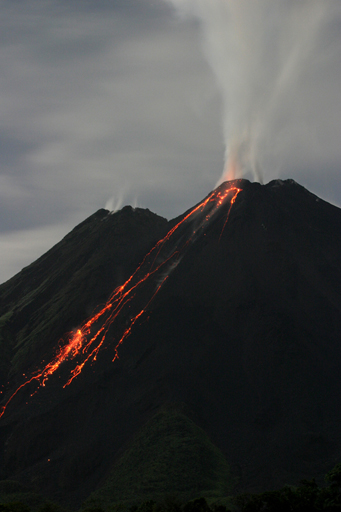
We have been investigating the rates, overall extents, and mechanisms of degassing and crystallization for magmas with differing compositions from different tectonic settings. The ultimate goal is to mitigate the hazards posed by explosive volcanic eruptions. Our focus is on (210Pb/226Ra) activity ratios in lavas and contained minerals. The short half-life of 210Pb (T1/2 = 22.6. y) allows us to focus on the crucial period of the final century before an eruption. Persistent losses of 222Rn as magmas degas before eruption lead to deficits in 210Pb with respect to 226Ra, whereas 210Pb excesses can result from persistent enrichments of 222Rn due to streaming of gasses from magmas at depth. Our recent observations suggest that lavas erupted from volcanoes associated with subduction have (210Pb/226Ra) values that tend towards equilibrium (1.0), whereas ocean island basalts (OIB), tend to have 210Pb deficits (e.g. Reagan et al., 2017). This appears paradoxical, as it is the low-volatile-content OIB lavas that appear to persistently lose 222Rn for years, whereas arc lavas, which lose much more gas, appear to rarely do so for more than a year or two before eruption. The purpose of our ongoing reserarch is to determine whether the root cause of this difference is indeed degassing, or to other processes such as fractionation of sulfides. We also have found that mineral growth occurs in both tectonic settings within a few decades of eruption (Reagan et al., 2008; Sims et al., 2013), and that rapid crystal fractionation could be the norm for many volcanoes.


Volcanism and subduction initiation
We have been studying the early history of the Izu-Bonin-Mariana (IBM) by analyzing rocks collected during IODP Expedition 352, recent Shinkai 6500 diving and field work on the forearc islands of Guam, Rota, and Saipan. We have used major element, trace element, and Sr-Nd-Pb-Hf isotope compositions of whole rocks and pillow-rind glasses to characterize how lava compositions have changed from the inception of subduction to the extablishment of a volcanic arc. We have discovered that the forearc along its length has an ophiolitic geology, with peridotites at greatest depth, and outcrops of gabbros, dolerites, basalts, boninites and arc lavas progressively upslope. We have concluded that magma generation after subduction initiation began with near-trench seafloor spreading and decompression melting to produce basalts. Flux melting to generate boninites began shortly thereafter, and the transition to normal arc volcanism was complete within about 8 million years (see Reagan et al., 2010; Ishizuka et al., 2011; Reagan et al., 2013; Reagan et al., 2017).